
5 Common Termination Mistakes That Could Cost Your Hong Kong Business Millions
Firing someone is never easy. But in Hong Kong, getting it wrong can cost your business hundreds of thousands of dollars in legal fees, severance payments, and tribunal awards. The Employment Ordinance is strict, and employees know their rights better than ever.
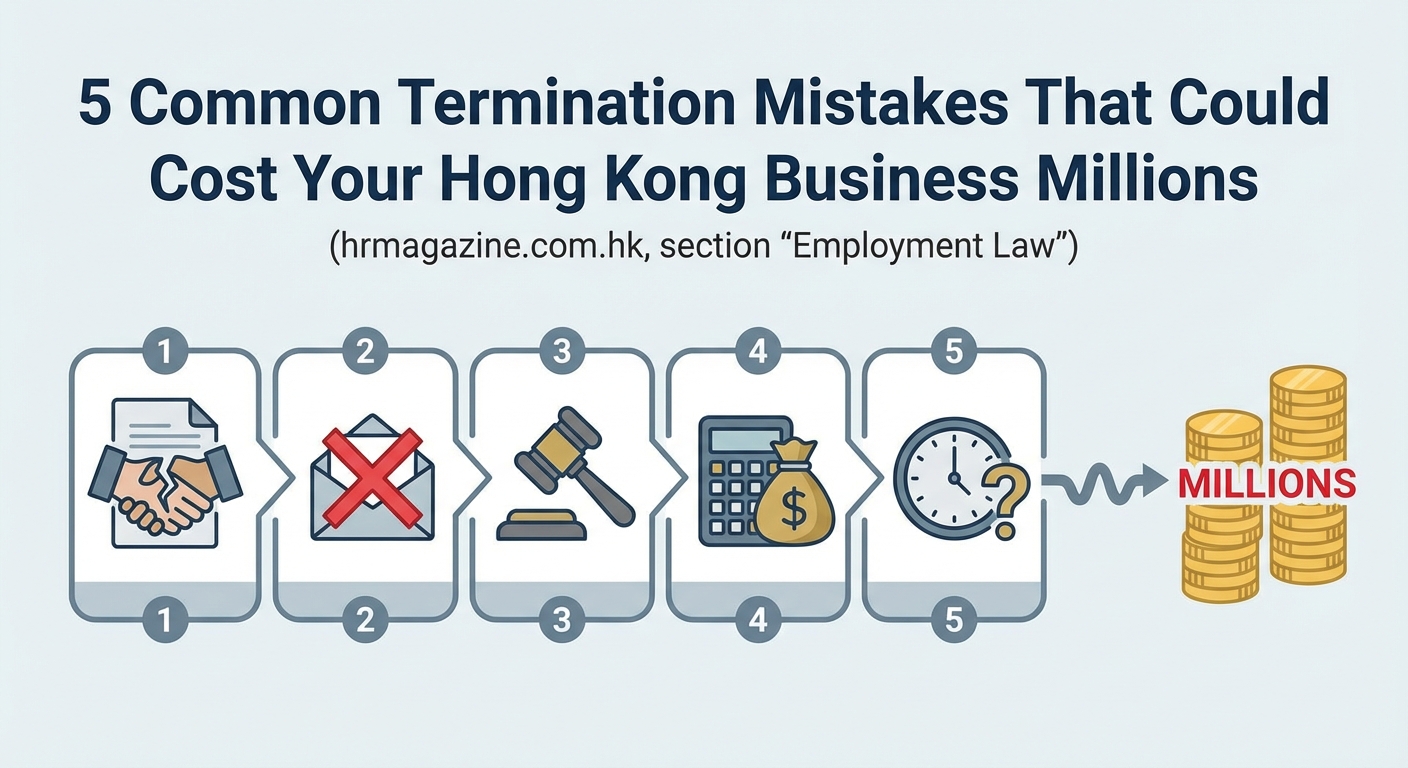
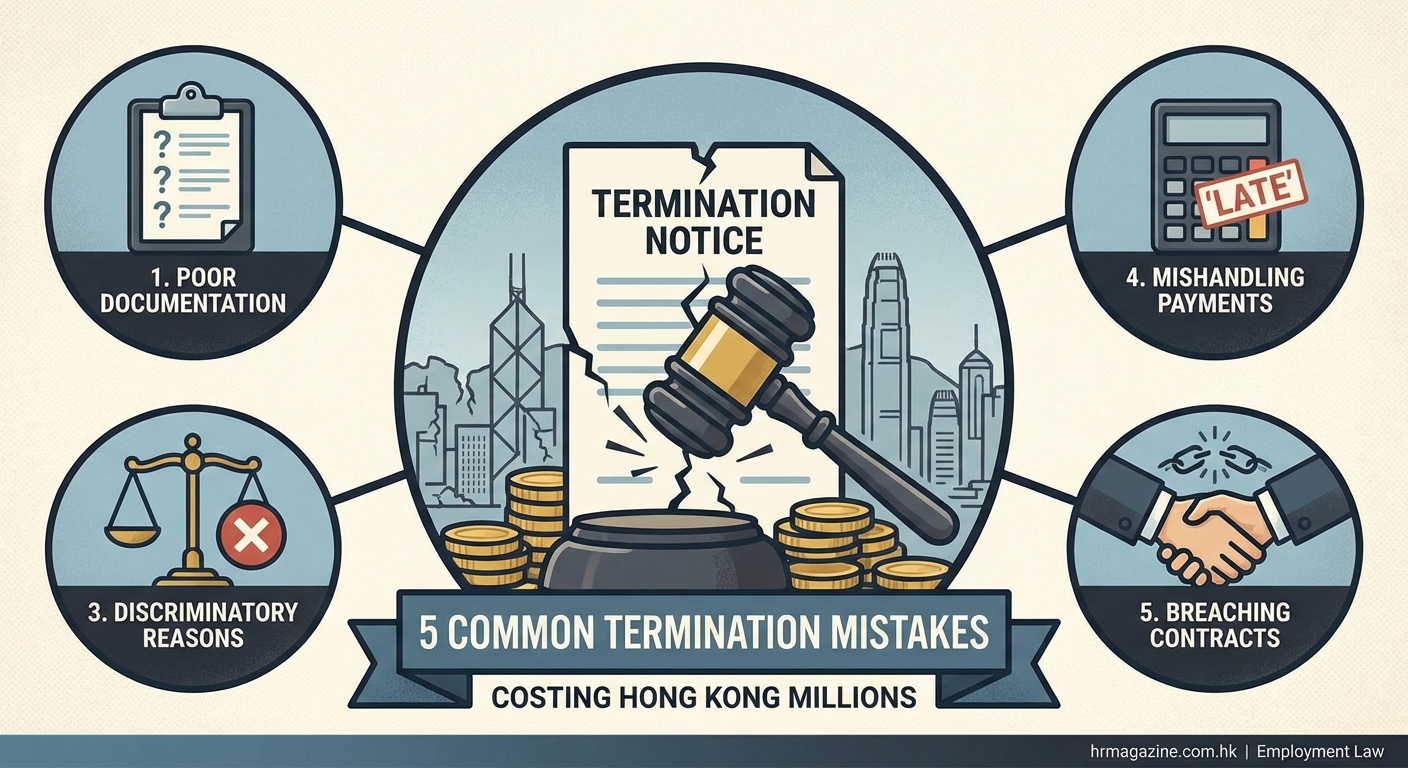
Hong Kong employers face serious financial and legal risks when terminating employees improperly. Common mistakes include inadequate documentation, miscalculated severance, failure to follow contractual notice periods, discriminatory dismissals, and poor communication. Understanding these pitfalls and implementing proper termination procedures protects your business from costly tribunal claims, reputational damage, and regulatory penalties while ensuring fair treatment of departing employees.
Most HR managers think they understand termination law. They’ve handled a few dismissals, read the employment contracts, and believe they’re covered. Then a tribunal claim arrives, and suddenly they’re facing six months of legal battles over a single firing decision.
The truth is that employee termination mistakes in Hong Kong happen more often than you’d think. Even experienced HR teams make errors that turn routine dismissals into expensive legal nightmares.
Missing or incomplete documentation
Your memory of performance issues won’t hold up in a tribunal. Neither will verbal warnings that nobody recorded. Hong Kong’s Labour Tribunal expects employers to produce clear, dated evidence for every claim they make about an employee’s conduct or performance.
Many businesses operate on trust and informal communication. A manager tells an underperforming employee to “do better” over coffee. Nothing gets written down. Months later, when the company decides to terminate, they have no paper trail to justify the decision.
This approach fails spectacularly in tribunal hearings.
The Employment Ordinance doesn’t require employers to prove wrongful dismissal. Employees must prove it. But without documentation, you can’t defend your position effectively. The tribunal will often side with the employee when evidence is lacking.
Here’s what proper documentation looks like:
- Written performance reviews conducted at regular intervals, signed by both parties
- Formal warning letters that specify the problem, expected improvements, and timeline
- Meeting notes from disciplinary discussions, including the employee’s response
- Email trails showing you gave the employee opportunities to improve
- Records of any training or support provided to address performance gaps
A manufacturing company in Kwun Tong recently learned this lesson the hard way. They dismissed a warehouse supervisor for repeated tardiness but had no written warnings on file. The supervisor claimed he was never told his punctuality was a problem. The tribunal awarded him three months’ wages plus legal costs. Total damage: HK$180,000 for a position that paid HK$22,000 monthly.
Start documenting from day one. Even small issues deserve a brief email confirmation. “Following our conversation today about the inventory discrepancy, we agreed you’ll implement the new checking procedure starting Monday.” Simple, clear, dated.
“Documentation isn’t about creating a hostile environment. It’s about clarity and fairness. Employees deserve to know exactly where they stand, and written records ensure everyone remembers the same conversation the same way.”
Calculating severance and long service payments incorrectly
Hong Kong’s severance payment and long service payment rules confuse even experienced HR professionals. The calculations involve specific formulas, caps, and eligibility criteria that change based on employment duration and termination circumstances.
An employee qualifies for severance payment if they’ve worked for you continuously for at least 24 months and you dismiss them due to redundancy. They qualify for long service payment if they’ve worked for at least five years and you terminate them for reasons other than serious misconduct.
You cannot pay both. The employee receives whichever is applicable and higher.
The calculation formula: (monthly wage × 2/3) × years of service. But “monthly wage” has a cap of HK$22,500, even if the employee earns more. And you calculate years of service differently depending on whether the termination happens before or after the employee’s service anniversary.
Here’s where businesses make expensive mistakes:
| Mistake | Why It Happens | Financial Impact |
|---|---|---|
| Using actual salary instead of capped amount | Misreading the ordinance | Overpayment of 30-50% |
| Forgetting to deduct MPF employer contributions | Not understanding the offset mechanism | Overpayment of 15-25% |
| Rounding service years incorrectly | Using calendar years instead of employment years | Under or overpayment |
| Missing the redundancy vs. dismissal distinction | Poor termination reason documentation | Wrong payment type, potential tribunal claim |
| Ignoring partial year calculations | Assuming only full years count | Underpayment, tribunal exposure |
A property management firm in Tseung Kwan O dismissed 12 employees during a restructure. They calculated severance using each employee’s full monthly salary without applying the statutory cap. They overpaid by HK$340,000 across the group. The excess wasn’t recoverable because employees have no obligation to return overpayments.
Another common error involves the MPF offset. Employers can use their MPF contributions to offset severance or long service payments. But many HR teams forget this step or calculate it wrong, leaving money on the table.
Get your calculations verified by an employment lawyer or experienced HR consultant before you make payments. The cost of a professional review is far less than the cost of getting it wrong.
Ignoring contractual notice requirements
Employment contracts in Hong Kong typically specify notice periods for termination. Standard periods range from one week for new employees to three months for senior staff. These are contractual obligations, not suggestions.
Many employers assume they can bypass notice by paying salary in lieu. Sometimes they can. But only if the employment contract explicitly allows payment in lieu of notice. If your contract is silent on this point, you must provide actual notice or risk a breach of contract claim.
The Employment Ordinance sets minimum statutory notice periods based on tenure:
- Less than one month of service: no notice required
- One month to less than two years: seven days
- Two years or more: one month
Your contract can require longer notice than these minimums. It cannot require less.
A financial services company in Central dismissed a compliance officer with immediate effect, paying one month’s salary in lieu. The employment contract required three months’ notice but didn’t mention payment in lieu. The officer sued for breach of contract and won two months’ additional salary plus legal costs. Total cost: HK$280,000.
Some contracts include garden leave clauses, allowing you to exclude the employee from the workplace during the notice period while still paying them. This protects sensitive information and client relationships. But garden leave still requires you to pay full salary and benefits for the entire notice period.
Here’s a practical checklist for notice period compliance:
- Review the employment contract before initiating termination
- Verify whether payment in lieu is contractually permitted
- Calculate the exact notice period based on the contract, not the ordinance minimum
- Confirm whether the employee has unused annual leave that extends the notice period
- Document the notice delivery method and date
- Maintain all benefits during the notice period, including insurance and MPF contributions
Never assume you can negotiate notice periods down after you’ve issued a termination letter. Once you’ve committed to a specific period in writing, you’re bound by it.
Failing to consider discrimination risks
Hong Kong’s discrimination ordinances protect employees from dismissal based on sex, pregnancy, marital status, disability, family status, and race. These protections are broad, and tribunals interpret them generously in favor of employees.
Discrimination claims are particularly dangerous because they carry no compensation caps. A successful discrimination claim can result in awards far exceeding typical wrongful dismissal settlements.
The problem is that discrimination isn’t always obvious. You might dismiss someone for legitimate performance reasons, but if the timing coincides with a protected characteristic, you face risk.
Consider these scenarios:
-
An employee’s performance declines after returning from maternity leave. You document the issues and eventually dismiss her. She claims pregnancy discrimination, arguing her performance problems resulted from exhaustion and lack of workplace support for new mothers.
-
A 58-year-old manager gets made redundant while younger colleagues keep their jobs. He claims age discrimination, even though your redundancy selection was based on skills and business needs.
-
An employee discloses a mental health condition and requests flexible working arrangements. You deny the request and later dismiss him for attendance issues. He claims disability discrimination.
Each of these situations involves legitimate business decisions. But each also creates discrimination exposure if you can’t prove your decision-making was genuinely independent of the protected characteristic.
A retail chain dismissed a pregnant store manager for poor sales performance. They had documentation showing declining metrics over six months. But the tribunal noted that the company had never dismissed anyone else for similar performance levels. The timing of the dismissal, three weeks after the manager disclosed her pregnancy, created an inference of discrimination. Award: HK$450,000 plus legal costs.
Protect yourself by following these steps:
- Apply termination criteria consistently across all employees
- Document business reasons thoroughly and contemporaneously
- Consider whether the timing of the dismissal creates any inference of discrimination
- Review recent requests for accommodations or disclosures of protected characteristics
- Ensure the decision-maker can articulate clear, non-discriminatory reasons for the termination
If an employee has recently disclosed a protected characteristic, get legal advice before proceeding with termination. The cost of a consultation is minimal compared to the cost of a discrimination claim.
Mishandling the termination conversation
The actual termination meeting is where many employers create unnecessary problems. Poor communication turns a straightforward dismissal into an emotional confrontation that generates evidence for tribunal claims.
Common mistakes include:
- Conducting the meeting without a witness present
- Allowing the conversation to become argumentative
- Making statements that contradict the written termination letter
- Discussing details you haven’t verified
- Making promises about references or rehiring that you can’t keep
A logistics company manager told a dismissed driver, “This isn’t personal, we just need to cut costs.” The termination letter cited performance issues. The inconsistency between the verbal and written reasons became central evidence in the driver’s wrongful dismissal claim. The tribunal found the termination was actually redundancy, not performance-based, requiring severance payment the company hadn’t made.
Here’s a better approach:
Before the meeting:
– Prepare a written termination letter with clear, accurate reasons
– Arrange for a witness, typically another manager or HR representative
– Gather all relevant documents, including the employment contract and any final payments
– Plan what you’ll say and stick to the script
During the meeting:
– Keep it brief, ideally 10-15 minutes
– State the decision clearly at the start
– Refer to the written letter for details
– Allow the employee to respond but don’t debate the decision
– Explain next steps, including final pay, return of company property, and reference procedures
– Remain professional regardless of the employee’s reaction
After the meeting:
– Document what was said by both parties
– Process final payments promptly
– Arrange for collection of company property
– Deactivate system access immediately
– Brief remaining team members appropriately
Never dismiss someone via email, text message, or phone unless they’re on extended leave and you’ve exhausted other options. Face-to-face termination meetings, while uncomfortable, reduce misunderstandings and demonstrate respect.
Protecting your business through proper procedures
Employee termination mistakes in Hong Kong are expensive, but they’re also preventable. The businesses that avoid tribunal claims aren’t lucky. They’re disciplined about documentation, calculation accuracy, contractual compliance, discrimination awareness, and communication quality.
Start building better termination practices today. Review your current employment contracts to verify notice period clauses. Implement a documentation system for performance issues and disciplinary matters. Train managers to recognize discrimination risks. Create termination checklists that cover calculations, notice periods, and meeting procedures.
When termination becomes necessary, slow down. Verify every detail. Get legal advice when situations involve protected characteristics or complex calculations. The hour you spend preparing properly saves months of tribunal stress and hundreds of thousands in potential awards.
Your employees deserve fair treatment. Your business deserves protection from avoidable legal claims. Proper termination procedures deliver both.