
5 Critical Skills Hong Kong Employees Must Develop Before 2025
The job market in Hong Kong is shifting faster than most people realize. AI tools are replacing routine tasks. Automation is reshaping entire departments. And the skills that made someone valuable in 2023 might not cut it by the end of 2025. For HR professionals and managers, this isn’t just about hiring anymore. It’s about preparing your entire workforce for a workplace that looks fundamentally different from the one we knew just two years ago.
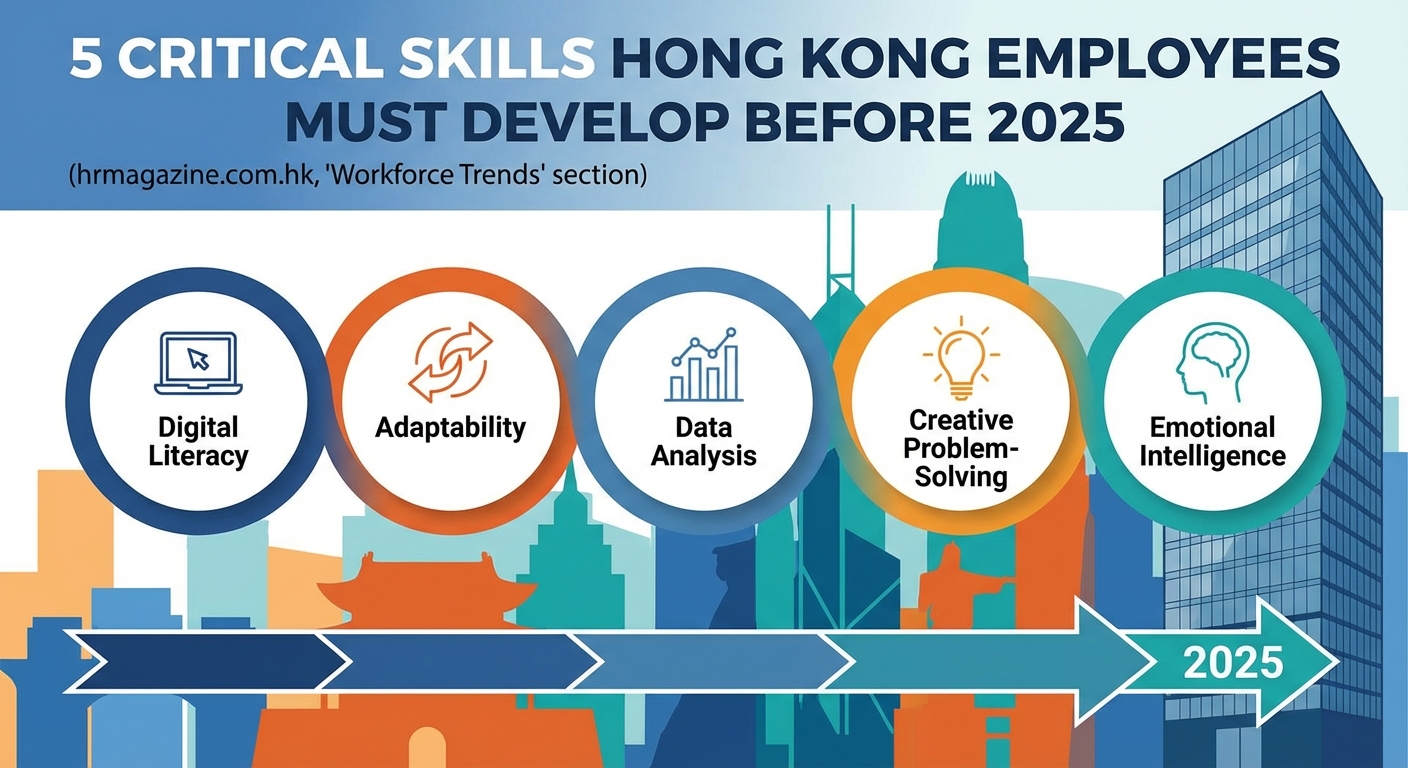
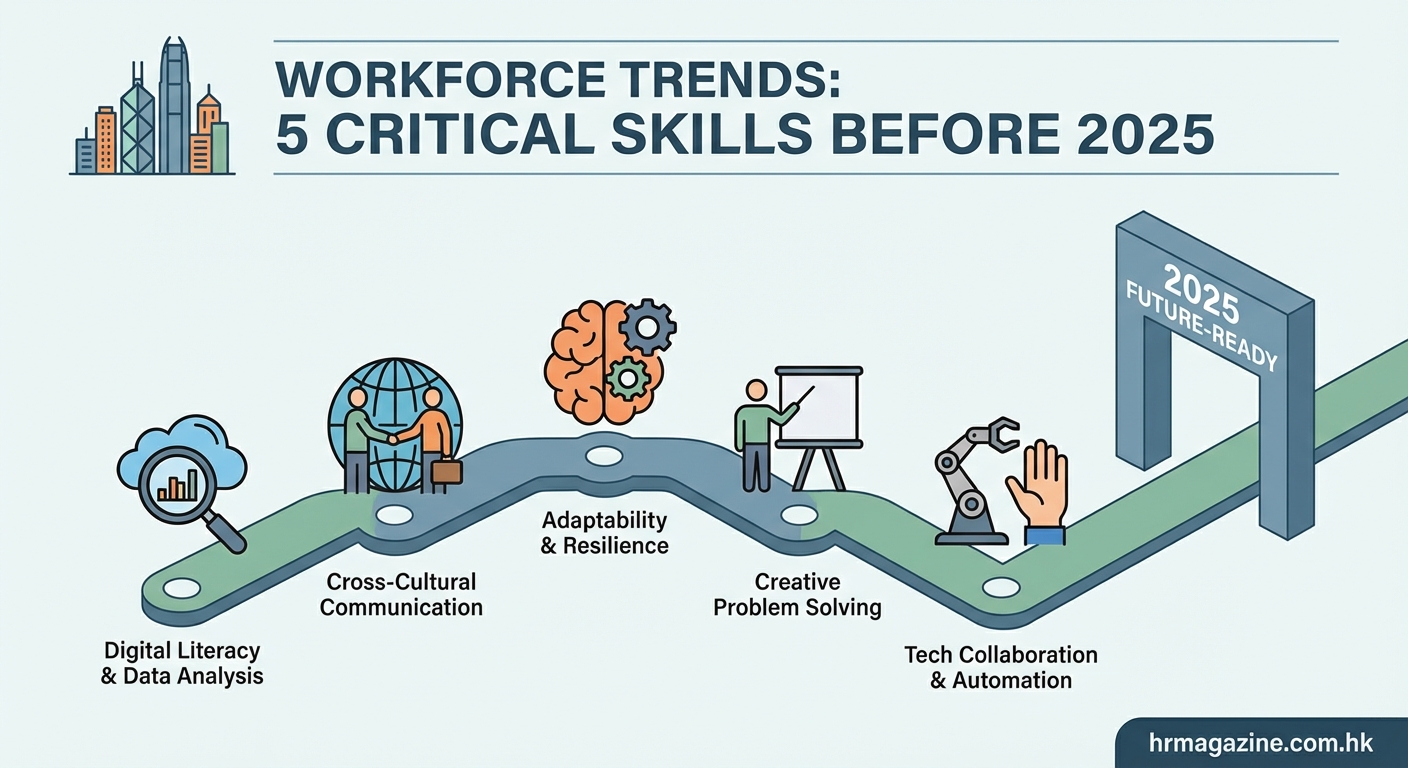
The skills employees need in 2025 center on human capabilities that AI cannot replicate. Critical thinking, adaptability, emotional intelligence, digital fluency, and creative problem-solving now define career resilience in Hong Kong’s evolving workplace. Organizations investing in these competencies today will outperform competitors struggling with outdated talent strategies tomorrow. This shift requires immediate action from HR leaders and forward-thinking professionals.
Why 2025 marks a turning point for workplace skills
The World Economic Forum’s Future of Jobs Report identifies 2025 as a critical inflection point. Half of all employees will need reskilling as adoption of technology accelerates. In Hong Kong specifically, sectors from finance to logistics are automating faster than regional averages.
This creates a paradox. Technology eliminates certain jobs while creating demand for uniquely human skills. The employees who thrive will be those who complement AI rather than compete with it.
Many Hong Kong companies are already feeling this pressure. Recruitment challenges intensify when organizations can’t find candidates with the right skill mix. Traditional qualifications matter less. Adaptive capabilities matter more.
Critical thinking and analytical reasoning
AI can process data. It cannot question assumptions or challenge flawed premises. That’s where human critical thinking becomes irreplaceable.
Critical thinking means evaluating information objectively, identifying biases, and making sound judgments even with incomplete data. In 2025, this skill separates employees who blindly accept AI outputs from those who validate and improve them.
Consider a marketing team using AI to generate campaign ideas. An employee with strong critical thinking will:
- Assess whether AI recommendations align with brand values
- Identify cultural nuances the algorithm missed
- Recognize when data patterns don’t account for recent market shifts
- Challenge outputs that seem plausible but lack strategic coherence
Hong Kong’s fast-paced business environment makes this especially valuable. Decisions often need to happen under pressure with imperfect information. Employees who can think clearly under these conditions become organizational anchors.
How to develop critical thinking skills
Start with structured questioning frameworks. The “Five Whys” technique helps employees dig beneath surface-level explanations. Scenario planning exercises build comfort with ambiguity.
Cross-functional projects also strengthen critical thinking. When finance professionals work alongside operations teams, they learn to evaluate problems from multiple perspectives. This cognitive flexibility is exactly what 2025 workplaces demand.
Adaptability and continuous learning
The half-life of technical skills keeps shrinking. A programming language that’s essential today might be obsolete in three years. Cloud platforms evolve constantly. Regulatory frameworks shift.
Adaptability isn’t about learning faster. It’s about being comfortable with perpetual learning as a baseline condition of work.
“The employees who succeed in 2025 won’t be those who know the most today. They’ll be the ones who can learn, unlearn, and relearn as their roles evolve.” – HR Director, Hong Kong Financial Services Firm
This mindset shift challenges traditional career planning. Instead of mastering a fixed skill set, employees need to build learning agility. That means recognizing when their knowledge is outdated, seeking new information sources, and applying fresh concepts without extensive handholding.
For HR teams, this changes training approaches fundamentally. One-time workshops don’t work anymore. Continuous learning systems with microlearning, peer coaching, and on-demand resources become essential infrastructure.
Building organizational adaptability
Create psychological safety first. Employees won’t experiment with new approaches if they fear punishment for mistakes. Building that safety requires intentional culture work.
Then provide structured learning pathways. Employees need clear guidance on which skills matter most for their roles. Vague encouragement to “keep learning” rarely produces results.
Emotional intelligence and interpersonal skills
As AI handles more technical tasks, the remaining human work becomes increasingly relational. Negotiating with stakeholders. Managing team dynamics. Reading unspoken concerns in client meetings. Providing empathetic customer service.
These capabilities all require emotional intelligence: the ability to recognize, understand, and manage emotions in yourself and others.
Hong Kong’s workplace culture historically emphasized technical competence over soft skills. That’s changing rapidly. Organizations realize that brilliant analysts who can’t collaborate effectively create more problems than they solve.
Emotional intelligence includes several distinct competencies:
- Self-awareness of your emotional triggers and patterns
- Self-regulation to manage reactions productively
- Social awareness to read others accurately
- Relationship management to influence and inspire
The business case is clear. Teams with higher emotional intelligence show better performance, lower turnover, and stronger innovation metrics. In customer-facing roles, emotional intelligence directly impacts satisfaction and retention.
Practical development strategies
Emotional intelligence grows through practice and feedback. 360-degree assessments help employees understand how others perceive their interpersonal effectiveness. Coaching relationships provide safe spaces to process challenging interactions.
Role-playing difficult conversations builds comfort with emotional complexity. When employees rehearse delivering tough feedback or managing conflict, they develop skills that transfer to real situations.
Leadership development programs increasingly prioritize emotional intelligence alongside traditional management training. The best programs combine conceptual learning with real-world application and reflection.
Digital fluency and AI collaboration
You don’t need to be a programmer to work effectively in 2025. But you do need digital fluency: comfort using technology tools, understanding their capabilities and limitations, and knowing when to apply them.
This goes beyond basic software proficiency. Digital fluency means understanding how AI systems make decisions, recognizing their biases, and prompting them effectively to get useful outputs.
Consider these scenarios Hong Kong employees face today:
| Scenario | Required Digital Fluency |
|---|---|
| Using AI to draft client proposals | Understanding prompt engineering, recognizing generic outputs, knowing when human creativity is essential |
| Analyzing sales data with automated tools | Interpreting visualizations, questioning anomalies, understanding statistical significance |
| Managing hybrid team collaboration | Selecting appropriate platforms, maintaining engagement across channels, balancing synchronous and asynchronous work |
| Protecting customer data privacy | Understanding encryption basics, recognizing phishing attempts, following security protocols |
The gap between digitally fluent employees and those struggling with technology will widen dramatically by 2025. Organizations can’t afford to have team members who avoid digital tools or use them ineffectively.
Building digital fluency across your workforce
Start with current-state assessments. Where do employees struggle with existing tools? What technologies do they avoid? Understanding these patterns helps target development efforts.
Peer learning often works better than formal training for digital skills. Employees who master new tools can demonstrate practical applications to colleagues. This builds confidence and shows relevance more effectively than abstract instruction.
AI-powered recruitment tools provide one example where HR teams themselves need digital fluency. Understanding how these systems work helps you evaluate vendors, avoid algorithmic bias, and use the technology strategically.
Creative problem-solving and innovation
AI excels at optimization. It can find the most efficient route, the optimal price point, or the best-performing ad variation. What AI cannot do is reframe problems entirely or imagine solutions that don’t exist in its training data.
That’s where human creativity becomes a competitive advantage. The ability to see connections between unrelated domains. To question whether you’re solving the right problem. To prototype unconventional approaches.
Hong Kong’s business environment rewards this kind of thinking. The city’s role as a connector between mainland China and global markets creates constant opportunities for innovative solutions.
Creative problem-solving has several components:
- Problem reframing: Looking at challenges from multiple angles
- Divergent thinking: Generating many possible solutions without immediate judgment
- Combinatorial creativity: Blending ideas from different fields
- Prototyping mindset: Testing concepts through small experiments rather than extensive planning
These skills matter across roles. A finance professional who reimagines budget processes. An HR manager who designs novel recognition programs. A customer service representative who creates new ways to resolve recurring complaints.
Fostering creativity in structured environments
Many Hong Kong organizations struggle with this. Hierarchical structures and risk-averse cultures can suppress creative thinking. Changing this requires deliberate effort.
Create space for experimentation. Google’s famous “20% time” policy lets employees work on passion projects. Even smaller commitments like monthly innovation hours can spark creative thinking.
Diverse teams produce more creative solutions. When people with different backgrounds, expertise, and perspectives collaborate, they challenge each other’s assumptions and generate more novel ideas.
Common skill development mistakes to avoid
Organizations investing in workforce development often make predictable errors that undermine their efforts.
| Mistake | Why It Fails | Better Approach |
|---|---|---|
| One-size-fits-all training | Different roles need different skills; generic programs waste time | Personalize learning paths based on role requirements and individual gaps |
| Focusing only on technical skills | Ignores the human capabilities AI cannot replace | Balance technical and human-centered skill development |
| No reinforcement after training | Skills fade without practice and application | Build ongoing practice opportunities and accountability |
| Ignoring manager capability | Managers who can’t model or coach new skills limit team development | Develop managers first, then cascade to teams |
| Measuring completion instead of application | Tracking who attended training doesn’t show business impact | Assess on-the-job behavior change and performance outcomes |
The most damaging mistake is treating skill development as an HR initiative rather than a business imperative. When learning is siloed in HR with minimal line manager involvement, it rarely sticks.
Executive coaching can support senior leaders in modeling continuous learning. When executives visibly prioritize their own development, it signals that learning matters at all levels.
How to assess current skill gaps in your organization
You can’t develop skills strategically without knowing where gaps exist. Many organizations guess at this rather than measuring systematically.
Start with role-based competency frameworks. What skills does each role require to perform effectively in 2025? Compare that to current capabilities. The delta is your development priority.
Multiple data sources improve accuracy:
- Manager assessments of team member capabilities
- Self-assessments to gauge employee confidence and awareness
- Performance data showing where work quality suffers
- Customer feedback highlighting service gaps
- Project post-mortems revealing recurring problems
Look for patterns across these sources. If managers, employees, and performance data all point to weak critical thinking skills in your analytics team, that’s a clear development priority.
Identifying red flags during hiring also reveals organizational skill gaps. If you’re consistently hiring for the same missing capabilities, that suggests your development programs aren’t closing those gaps internally.
Creating individual development plans that work
Generic development plans sit in drawers unused. Effective plans connect personal career goals with organizational needs and include concrete actions.
A strong individual development plan includes:
- Specific skills to develop with clear definitions
- Why these skills matter for the employee’s career and current role
- Development activities with timelines and resources
- Practice opportunities to apply new skills
- Success metrics to track progress
- Manager support commitments
The plan should be a working document, reviewed and updated quarterly. As the employee makes progress or as business needs shift, the plan evolves.
Managers play a critical role here. They need to create opportunities for employees to practice new skills in real work contexts. An employee developing presentation skills needs chances to present. Someone building data analysis capabilities needs projects requiring that work.
Making learning part of daily work
The most effective skill development doesn’t happen in classrooms. It happens through structured work experiences that stretch capabilities just beyond current comfort levels.
This requires intentional job design. Can you restructure projects to give employees exposure to new challenges? Can cross-functional assignments build broader perspectives? Can mentoring relationships transfer tacit knowledge that’s hard to teach formally?
Employee experience platforms can support this by making learning resources accessible in the flow of work. When an employee encounters an unfamiliar task, they can immediately access relevant microlearning content or connect with an expert.
The goal is making learning feel less like an extra burden and more like an integrated part of how work happens. When employees see immediate applications for new skills, motivation and retention both improve.
Measuring the business impact of skill development
CFOs and business leaders increasingly question training ROI. Vague claims about “building capabilities” don’t justify significant investments. You need to demonstrate business impact.
Start by connecting skill development to business outcomes. If you’re developing critical thinking skills in your product team, what business results should improve? Faster time to market? Fewer product failures? Higher customer satisfaction?
Then measure those outcomes before and after development interventions. Control for other variables where possible. If your trained group shows significantly better results than comparable untrained groups, you have evidence of impact.
Leading indicators also matter. Are employees applying new skills on the job? Are managers seeing behavior changes? Are project outcomes improving? These signals appear before financial results shift.
Document success stories. When an employee applies newly developed skills to solve a real business problem, capture that example. These narratives make the value of development tangible for skeptical stakeholders.
Why investing now prevents crisis later
The temptation is to delay skill development investments. Training budgets are easy to cut when business conditions tighten. But this creates a dangerous cycle.
Organizations that underinvest in capability building face escalating problems:
- Declining competitiveness as rivals pull ahead
- Difficulty attracting talent who want to work for learning-focused employers
- Higher turnover as ambitious employees leave for better development opportunities
- Inability to adopt new technologies because staff lack necessary skills
- Crisis-driven scrambling when critical capabilities suddenly become essential
By contrast, organizations that invest consistently in workforce development build resilience. They can adapt to market shifts because their people can adapt. They attract stronger talent. They promote from within more successfully.
The skills employees need in 2025 won’t appear magically. They require deliberate development starting now. The organizations that recognize this urgency will separate themselves from competitors still operating with 2020 talent strategies.
Building your workforce for what’s actually coming
The future of work isn’t some distant abstraction anymore. It’s happening now in Hong Kong offices, factories, and service centers. AI tools are already changing how work gets done. The question isn’t whether your workforce needs new skills. It’s whether you’re developing those skills fast enough to keep pace with change.
Start small if you need to. Pick one critical skill gap and build a focused development program around it. Measure results. Learn what works in your specific context. Then scale those approaches to other skill areas. The organizations that treat workforce development as continuous strategic work rather than occasional training events will be the ones still thriving when 2025 arrives.