
5 Critical Mistakes HR Leaders Make When Designing Variable Pay Schemes in Hong Kong
Your finance director just approved a new variable pay scheme. You spent weeks designing it. The spreadsheet looks perfect. The metrics align with company goals.
Then the first payout cycle arrives. Three senior salespeople quit. Your legal team flags compliance issues. Employees complain the system feels unfair. Your CFO wants to know why costs exceeded projections by 40%.
This scenario plays out in Hong Kong offices every quarter. Variable pay schemes promise to align employee performance with business outcomes. But poor design creates more problems than it solves.
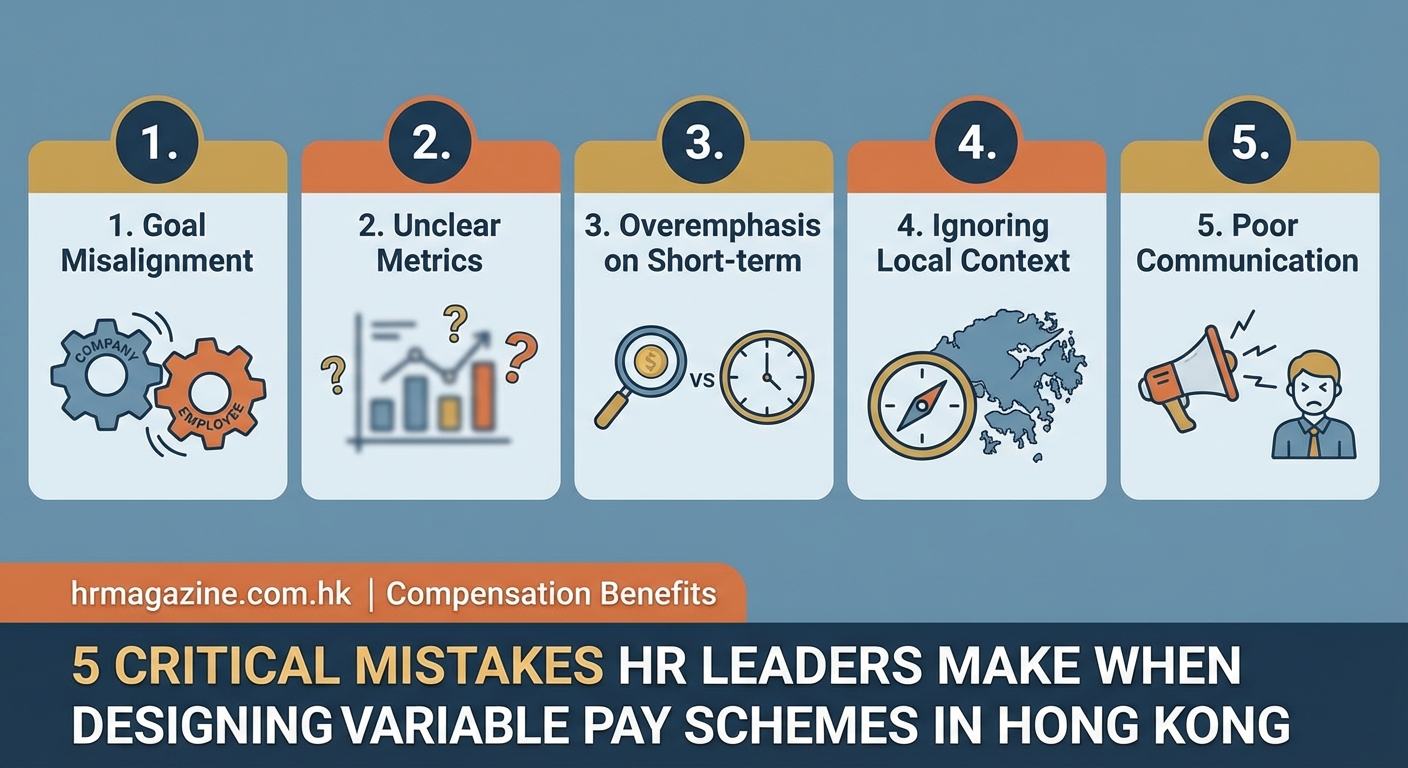
Hong Kong HR leaders commonly make five critical errors when designing variable pay schemes: ignoring Employment Ordinance requirements for discretionary bonuses, setting unrealistic performance targets, failing to communicate payout formulas clearly, neglecting market benchmarking, and designing overly complex structures. These mistakes lead to legal disputes, budget overruns, and talent loss. Successful variable pay requires clear documentation, realistic goals, transparent communication, regular market reviews, and simple administration that employees actually understand.
Treating all bonuses as discretionary when they are not
Many Hong Kong employers believe adding “discretionary” to their bonus policy protects them from legal obligations.
It does not work that way.
The Employment Ordinance distinguishes between genuinely discretionary payments and contractual entitlements. Courts examine the full employment relationship, not just policy wording.
If you pay a “discretionary” year end bonus every year for five consecutive years, employees can argue it became an implied term of their contract. If your offer letter mentions “annual performance bonus” without clear discretionary language, you have created an expectation.
The Labour Tribunal has repeatedly ruled against employers who tried to withhold bonuses they previously paid regularly. One 2023 case involved a financial services firm that stopped paying annual bonuses during a difficult year. Despite policy documents stating bonuses were discretionary, the Tribunal ordered payment because the company had paid them for seven consecutive years without exception.
How to structure genuinely discretionary bonuses:
- Never mention specific bonus amounts or percentages in offer letters
- Include clear discretionary language in employment contracts
- Document the decision making process for each bonus cycle
- Vary bonus amounts and timing year to year
- Communicate that business performance directly impacts whether bonuses are paid
If you want a contractual bonus scheme, make it explicit. Define the formula. Specify the performance metrics. Document everything.
Why Hong Kong startups are losing the war for tech talent often stems from unclear compensation structures that fail to compete with transparent offers from multinational firms.
Setting performance targets that guarantee failure or windfall payouts
Walk into most Hong Kong offices in January. Ask employees if they understand their variable pay targets.
Most cannot explain them. Worse, many targets were set without considering realistic market conditions or individual capacity.
Two common mistakes appear repeatedly:
Stretch targets with no floor: You set a 30% revenue growth target when the market is contracting. Employees give up before Q2 ends because the goal feels impossible. Variable pay loses all motivational value.
Threshold targets with unlimited upside: You design a scheme that pays 200% of target bonus if revenue exceeds projections by 15%. Then a competitor exits the market unexpectedly. Your sales team closes deals they did nothing to earn. Your compensation costs explode.
| Mistake Type | Example | Consequence |
|---|---|---|
| Unrealistic stretch | 40% growth in declining market | Demotivation, talent loss |
| No performance floors | All or nothing payout | Risk averse behavior |
| Unlimited upside | No cap on commission | Budget overruns |
| Lagging indicators only | Annual revenue only | No mid year course correction |
| Too many metrics | 12 different KPIs | Confusion, gaming |
“The best variable pay schemes balance aspiration with achievability. Targets should stretch your team without breaking them. Include threshold, target, and maximum performance levels. Cap payouts at a defined multiple of target bonus. Your finance team will thank you.”
Design your scheme with three performance zones:
Threshold performance (80 to 90% of target): Minimum acceptable performance. Pays 50% of target bonus. Ensures effort is rewarded even in challenging conditions.
Target performance (100%): Expected performance for a competent employee in normal conditions. Pays 100% of target bonus.
Maximum performance (120 to 150% of target): Exceptional performance. Pays 150 to 200% of target bonus. Capped to prevent budget surprises.
This structure maintains motivation across performance levels while protecting your budget.
Failing to communicate the payout formula clearly
You spent 40 hours building a sophisticated variable pay model. It accounts for individual performance, team results, and company profitability.
Your employees receive a one paragraph email explaining it.
Three months later, nobody understands why their bonus was HKD 8,420 instead of HKD 12,000.
Communication failures destroy variable pay effectiveness. Employees cannot modify behavior to improve outcomes they do not understand.
Common communication gaps:
- Publishing the scheme policy once during onboarding, then never again
- Using HR jargon like “pro rated EBITDA multiplier” without explanation
- Failing to provide mid year performance updates
- Not explaining how company performance affects individual payouts
- Withholding the actual calculation formula
One Hong Kong retailer faced mass resignations after employees discovered their “performance bonus” was actually calculated using a complex formula involving store performance, regional performance, and company profitability. Employees thought only their individual sales mattered. When high performing individuals received low bonuses due to poor regional results, they felt cheated.
Build a communication cadence:
- Scheme launch: Full explanation of metrics, calculation method, payout timing, and examples
- Quarterly updates: Current performance against targets, projected payout ranges
- Payout communication: Detailed breakdown showing exactly how the amount was calculated
- Annual review: Opportunity for questions and scheme refinement
Create a simple one page document showing the formula with real examples. If an employee with basic math skills cannot calculate their approximate bonus, your scheme is too complex.
Ignoring market data when setting variable pay levels

Your company offers a 10% target bonus for sales roles. Competitors offer 20% base salary plus uncapped commission.
You wonder why you cannot hire experienced salespeople.
Hong Kong’s talent market moves fast. Compensation practices that worked three years ago may no longer compete today. Variable pay expectations vary significantly by industry, role, and seniority level.
Market benchmarking mistakes:
- Using outdated salary surveys from 2019
- Comparing your fintech startup to investment banks
- Ignoring the fixed versus variable pay mix in your industry
- Assuming all roles should have the same variable pay percentage
- Never reviewing your scheme after initial design
A Hong Kong technology company designed their variable pay scheme by copying their parent company’s US model. They offered 15% target bonus for software engineers. Local market data showed Hong Kong tech companies typically offered 20 to 30% variable pay for similar roles, with many offering equity on top. The company struggled with retention until they adjusted their approach based on local market reality.
Benchmark these elements:
- Total cash compensation (base plus target variable)
- Variable pay as percentage of base salary by role and level
- Typical performance metrics for your industry
- Payout frequency (monthly, quarterly, annual)
- Mix of individual versus team versus company metrics
Professional compensation surveys from Mercer, Willis Towers Watson, and local HR associations provide Hong Kong specific data. Budget for annual survey participation. The investment pays for itself by preventing costly compensation mistakes.
How AI powered recruitment tools are reducing time to hire in Hong Kong’s competitive market becomes less relevant if your compensation packages cannot compete once candidates receive offers.
Building schemes so complex they require a PhD to administer
Your variable pay scheme uses 47 different data points. Calculating payouts requires three departments, two systems, and five days of work each quarter.
Employees receive their bonus statements and immediately email HR with questions. Your HR team spends the next two weeks explaining calculations.
Complexity kills variable pay effectiveness.
Signs your scheme is too complex:
- Payout calculations require custom spreadsheets that only one person understands
- You cannot explain the formula in under two minutes
- Different employees with identical performance receive wildly different payouts
- Processing payouts takes longer than two business days
- More than 30% of employees request payout explanations
A Hong Kong professional services firm designed a variable pay scheme with individual performance ratings, team performance scores, practice group profitability, office profitability, and firm wide profitability. Each component had different weightings that changed based on seniority level. Calculating bonuses required two weeks of work from the finance team. Employees could not predict their bonuses even roughly. The scheme created frustration instead of motivation.
Simplification principles:
- Limit metrics to three to five per role
- Use metrics employees can directly influence
- Make calculations possible with basic arithmetic
- Automate data collection where possible
- Test the scheme with a small group before company wide rollout
The best variable pay schemes balance sophistication with usability. A simple scheme that employees understand and trust will outperform a complex model that confuses everyone.
| Complexity Level | Metrics Count | Calculation Time | Employee Understanding | Effectiveness |
|---|---|---|---|---|
| Too simple | 1 | Minutes | 100% | Moderate (misses nuance) |
| Optimal | 3 to 5 | Hours | 80%+ | High |
| Too complex | 8+ | Days | Under 50% | Low (confusion) |
Consider whether your HRIS system can automate calculations. 5 cloud based HRIS systems that actually comply with Hong Kong’s privacy ordinance often include compensation management modules that reduce administrative burden.
Additional considerations for Hong Kong employers
Mandatory Provident Fund implications: Variable pay counts as relevant income for MPF purposes up to the maximum relevant income level. Factor MPF contributions into your total compensation costs.
Tax timing: Employees pay salaries tax on bonuses in the year received, not earned. Consider payout timing impacts on employee tax planning.
Severance and long service payment calculations: End of year bonuses paid in the 12 months before termination may be included in the employee’s average wages for calculating statutory payments. This can significantly increase termination costs.
Work visa considerations: For employees on employment visas, significant changes to compensation structure may require notification to the Immigration Department. Consult with immigration advisors before major scheme changes.
Cultural expectations: Hong Kong employees often expect year end bonuses around Chinese New Year. Consider cultural timing expectations in your payout schedule.
5 common termination mistakes that could cost your Hong Kong business millions frequently involve disputes about unpaid bonuses and whether they were truly discretionary.
Building variable pay schemes that actually work
The most effective variable pay schemes share common characteristics.
They use clear, measurable metrics that employees can influence through their daily work. They communicate expectations and progress transparently. They balance company, team, and individual performance appropriately. They pay out frequently enough to maintain motivation. They remain simple enough for both HR and employees to understand.
Start by defining what behaviors and outcomes you want to encourage. Revenue growth? Customer retention? Product quality? Cost management? Choose metrics that directly measure those outcomes.
Document everything. Put the scheme in writing. Include calculation formulas, payout timing, performance measurement methods, and examples. Have legal counsel review the documentation to ensure compliance with Hong Kong employment law.
Test the scheme with financial modeling. Run scenarios for different performance levels. Ensure the scheme remains affordable in high performance years and motivating in challenging years.
Communicate relentlessly. Employees should never be surprised by their variable pay amount. Regular updates on performance and projected payouts maintain engagement.
Review annually. Market conditions change. Business priorities shift. Your variable pay scheme should evolve accordingly. Survey employees about scheme clarity and fairness. Adjust based on feedback and results.
Building psychological safety becomes easier when employees trust that compensation practices are fair, transparent, and consistently applied.
Making variable pay work for your organization
Variable pay can powerfully align employee effort with business outcomes. But only when designed thoughtfully and administered consistently.
Avoid the five critical mistakes: treating contractual bonuses as discretionary, setting unrealistic targets, communicating poorly, ignoring market data, and building overly complex schemes.
Instead, create clear, fair, transparent systems that employees understand and trust. Document thoroughly. Communicate frequently. Review regularly.
Your variable pay scheme should motivate performance, not create confusion and resentment. Keep it simple. Keep it fair. Keep it legal.
The best time to fix variable pay mistakes is before they cost you top talent, legal fees, or budget overruns. Review your current scheme against these five mistakes. Make adjustments now, before the next payout cycle creates problems you could have prevented.