
7 Employee Recognition Programs That Actually Work in Hong Kong’s Hybrid Workplace
Your best performer just handed in her notice. Again.
She didn’t leave for a massive pay rise. She left because nobody noticed when she stayed late three nights running to finish that client pitch. Because her manager forgot to acknowledge her fifth work anniversary. Because the only time leadership mentioned her name was to assign more work.
Sound familiar? You’re not alone. Hong Kong’s hybrid workplace has made recognition harder than ever. Half your team works from home. The other half rotates through the office on different days. Traditional recognition methods like monthly team lunches or office shoutouts miss half your people.
But here’s the thing: employee recognition programs in Hong Kong don’t need to be complicated or expensive to work. They just need to be consistent, genuine, and designed for how your team actually works today.
Effective employee recognition programs in Hong Kong’s hybrid workplaces combine digital tools with cultural awareness. Successful programs focus on peer-to-peer recognition, milestone celebrations, real-time acknowledgment, and flexible rewards that work for both remote and office-based staff. The best programs cost less than replacing one employee but deliver measurably higher retention and engagement.
Why traditional recognition fails in hybrid settings
Remember when you could just walk over to someone’s desk and say thank you?
Those days aren’t coming back. At least not five days a week.
Hong Kong companies running hybrid models face a recognition gap. Office workers get face time with managers. Remote workers get forgotten. The inequality breeds resentment fast.
A 2024 survey of 500 Hong Kong employees found that 67% of remote workers felt less recognized than their office-based colleagues. Not because they performed worse. Because they weren’t physically present when praise happened.
Your Zoom-fatigued team won’t engage with another mandatory video call for recognition. They need programs that fit into their actual workflow.
Seven recognition programs that actually work in Hong Kong
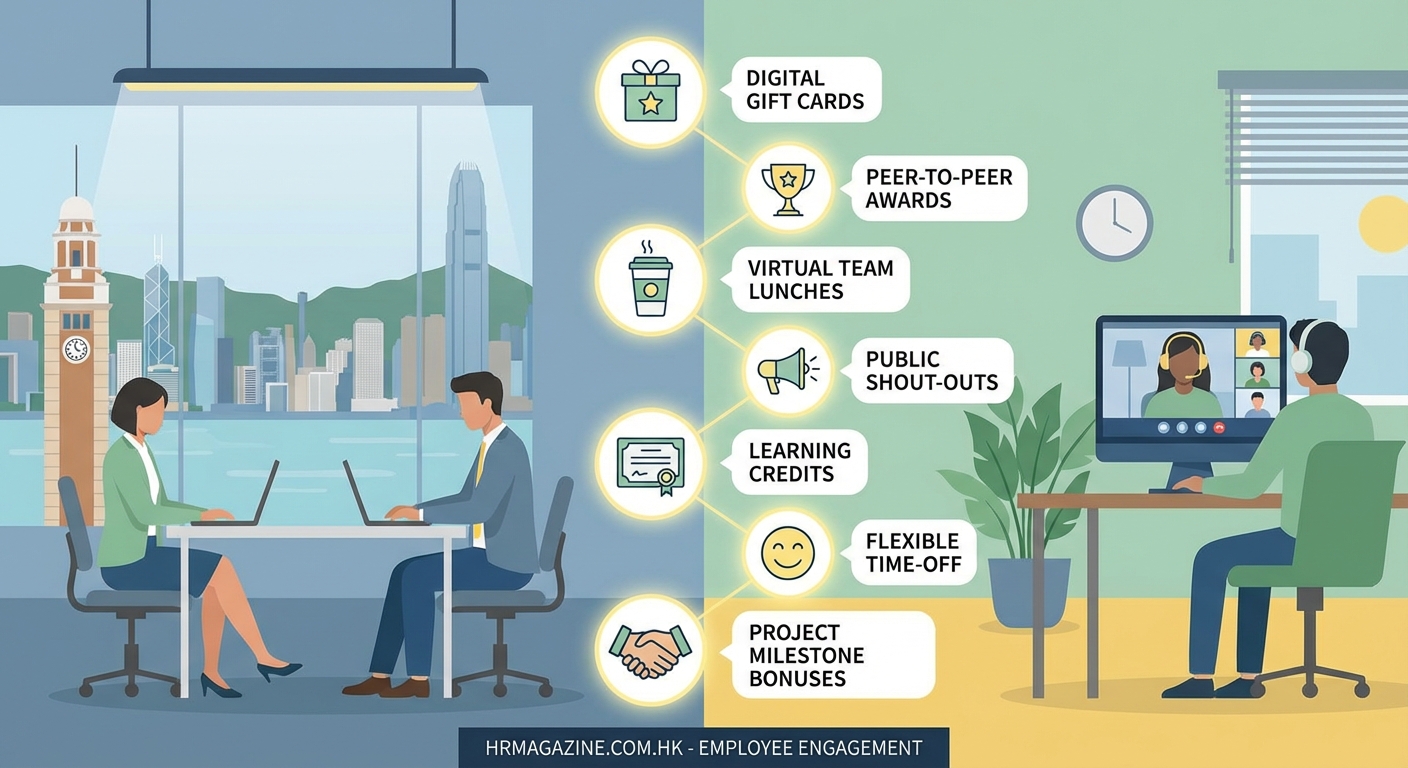
1. Digital peer-to-peer recognition platforms
Forget top-down recognition. Your employees know who’s doing great work better than any manager.
Peer-to-peer platforms let team members give instant recognition. Someone helps debug your code at 11pm? Send them a badge. A colleague covers your client call when you’re sick? Recognize them publicly.
The best platforms integrate with Slack or Microsoft Teams. Recognition happens where work happens. No separate app to remember. No monthly ceremony to schedule.
Hong Kong companies using peer recognition see 41% higher engagement scores. Because recognition becomes part of daily culture, not a quarterly afterthought.
What makes it work:
– Recognition happens in real time, not weeks later
– Everyone can participate, not just managers
– Remote and office workers have equal visibility
– Public acknowledgment builds team connection
2. Milestone-based recognition with cultural sensitivity
Hong Kong employees care about different milestones than Western workers might.
Work anniversaries matter. But so do Lunar New Year, Mid-Autumn Festival, and personal milestones like marriage or buying a first home.
Smart companies track these dates and recognize them appropriately. Not with generic gift cards. With thoughtful acknowledgment that shows you pay attention.
One Hong Kong fintech company gives employees a half-day off on their work anniversary, plus a personalized note from their manager highlighting specific contributions. Cost? Minimal. Impact? Their turnover dropped 28% in one year.
“Recognition without cultural context feels hollow. When we started acknowledging traditional festivals and family milestones, our employee satisfaction scores jumped 15 points in six months.” – HR Director, Hong Kong retail company
3. Real-time spot bonuses for exceptional work
Waiting until year-end reviews to recognize great work is like thanking someone for dinner three months later.
Spot bonuses work because they’re immediate. An employee lands a difficult client? Approve a HKD 2,000 bonus that week. Someone mentors a struggling team member back to productivity? Recognize it now.
The amount matters less than the timing. A HKD 1,000 bonus given immediately after exceptional work creates more goodwill than a HKD 5,000 year-end bonus buried in annual compensation.
Hong Kong’s competitive talent market means employees have options. Why Hong Kong startups are losing the war for tech talent and how to fight back often comes down to how valued people feel day-to-day.
4. Flexible recognition rewards that suit diverse preferences
Your 25-year-old developer wants different rewards than your 45-year-old account manager.
Cookie-cutter rewards fail. Everyone gets the same fruit basket. Nobody feels special.
Flexible reward platforms let employees choose what matters to them:
– Extra annual leave days
– Charitable donations in their name
– Shopping vouchers for specific retailers
– Professional development courses
– Wellness program credits
– Family experience vouchers
One Hong Kong logistics company switched from standard gift cards to a flexible platform. Employee satisfaction with recognition jumped from 52% to 84%. Same budget. Better targeting.
5. Manager training on recognition best practices
Your managers probably don’t know how to give good recognition.
They weren’t trained. They copy what they experienced. And what they experienced was probably inadequate too.
Effective recognition requires specific skills:
– Timeliness (within 24-48 hours of the achievement)
– Specificity (what exactly they did well)
– Impact explanation (how it helped the team or company)
– Public or private delivery based on employee preference
– Genuine tone without corporate jargon
Train your managers quarterly. Role-play recognition scenarios. Share examples of great recognition from across the company. Make it a core management competency, not an afterthought.
Companies that train managers on recognition see 60% higher program adoption rates. Because recognition becomes systematic, not random.
6. Virtual and in-person hybrid recognition events
Monthly all-hands meetings can work for recognition if you design them properly.
Hybrid events need dual-mode thinking. Office attendees get the room energy. Remote attendees get equal visibility and participation.
Hybrid recognition event checklist:
| Element | Office version | Remote version |
|---|---|---|
| Visibility | Stand at front of room | Camera spotlight, name on screen |
| Participation | Physical applause | Chat reactions, emoji responses |
| Keepsake | Printed certificate | Digital certificate emailed immediately |
| Follow-up | Photo opportunity | Screenshot shared in team channel |
One Hong Kong marketing agency runs monthly “wins” sessions. Every team shares their biggest achievement. Office and remote workers present equally. The session records and lives in their company knowledge base. New hires watch old sessions to understand what great work looks like.
7. Career development as recognition
Your top performers don’t want another coffee mug.
They want to grow. They want new challenges. They want to know you’re investing in their future.
Recognition through development opportunities works because it shows long-term commitment:
– Sponsoring professional certifications
– Funding conference attendance
– Assigning stretch projects
– Creating mentorship opportunities
– Supporting secondments to other departments
This approach particularly resonates in Hong Kong’s education-focused culture. Employees see development investment as serious recognition of their potential.
A Hong Kong professional services firm ties recognition to development. Top quarterly performers get first choice of new projects and training budgets. Their internal promotion rate hit 73%, while industry average sits at 41%.
Common recognition mistakes Hong Kong companies make
Even well-intentioned programs fail. Usually for predictable reasons.
Recognition program failure points:
| Mistake | Why it fails | Fix |
|---|---|---|
| Annual-only recognition | Too infrequent, feels transactional | Monthly minimum, ideally weekly |
| Manager-only recognition | Creates bottlenecks, misses peer contributions | Enable peer-to-peer recognition |
| One-size-fits-all rewards | Misses individual preferences | Offer choice in reward types |
| Ignoring remote workers | Creates two-tier culture | Design digital-first programs |
| No cultural adaptation | Feels imported, not authentic | Incorporate local festivals and values |
| Inconsistent delivery | Erodes trust in the program | Systemize with reminders and tracking |
The biggest mistake? Launching a recognition program and then letting it fade after three months.
Recognition needs executive sponsorship. Budget allocation. Regular measurement. Continuous improvement based on employee feedback.
Measuring what matters in recognition programs
You can’t improve what you don’t measure.
Track these metrics quarterly:
- Participation rate: What percentage of employees give or receive recognition monthly?
- Distribution equity: Do remote and office workers receive recognition equally?
- Manager engagement: Are all managers participating or just a few enthusiastic ones?
- Employee satisfaction: Does your engagement survey show recognition improvement?
- Retention correlation: Do recognized employees stay longer than non-recognized peers?
One Hong Kong tech company discovered through measurement that 80% of recognition went to just 30% of employees. The same high performers got recognized repeatedly. Average performers got ignored.
They adjusted their program to spotlight different contributions. Customer service excellence, not just sales numbers. Mentoring colleagues, not just individual achievement. Knowledge sharing, not just project delivery.
Within six months, recognition distribution evened out. And interestingly, overall performance improved as more people felt valued.
Budget realities for Hong Kong recognition programs
Let’s talk money.
Effective recognition doesn’t require massive budgets. But it does require intentional spending.
A realistic Hong Kong recognition budget breakdown for a 50-person company:
- Digital recognition platform: HKD 15,000-30,000 annually
- Spot bonuses pool: HKD 50,000-100,000 annually (HKD 1,000-2,000 per employee)
- Milestone recognition: HKD 25,000-50,000 annually
- Manager training: HKD 10,000-20,000 annually
- Flexible rewards platform: HKD 20,000-40,000 annually
Total annual cost: HKD 120,000-240,000 for 50 employees. That’s HKD 2,400-4,800 per employee per year.
Compare that to replacement costs. Losing one mid-level employee in Hong Kong costs 6-9 months of their salary in recruitment, onboarding, and productivity loss. For a HKD 40,000/month employee, that’s HKD 240,000-360,000.
Your recognition program pays for itself if it prevents losing just one employee annually.
Building your recognition program roadmap
Ready to implement? Follow this sequence.
Month 1: Foundation
1. Survey employees on current recognition gaps
2. Select your digital platform
3. Train managers on recognition basics
4. Launch peer-to-peer recognition pilot with one department
Month 2: Expansion
1. Roll out peer recognition company-wide
2. Implement spot bonus approval process
3. Create milestone tracking system
4. Schedule first hybrid recognition event
Month 3: Optimization
1. Gather employee feedback
2. Analyze participation and equity metrics
3. Adjust reward options based on preferences
4. Share success stories across the company
Month 4-6: Sustainability
1. Integrate recognition into performance reviews
2. Expand manager training to advanced techniques
3. Celebrate program wins publicly
4. Plan next quarter improvements
Don’t try to implement everything simultaneously. Phased rollouts build momentum and allow course correction.
Recognition programs work when leadership commits
Here’s the uncomfortable truth.
Your recognition program will only work if leadership participates visibly and consistently.
Employees watch what leaders do, not what HR emails say. When your CEO recognizes someone publicly, it matters. When department heads never participate, the program dies.
Leadership commitment means:
– Executives give recognition monthly, minimum
– Recognition appears in leadership communications
– Budget gets protected, not cut when times tighten
– Recognition data gets reviewed in leadership meetings
– Leaders share their own recognition stories
One Hong Kong company’s recognition program failed in year one. Participation hovered at 15%. They relaunched in year two with one change: the CEO started every leadership meeting by recognizing one employee by name, with specific achievement details.
Participation jumped to 68% in three months. Because employees saw that leadership actually cared.
Making recognition stick in Hong Kong’s work culture
Employee recognition programs in Hong Kong succeed when they respect local culture while adapting to modern hybrid work realities.
Your program needs digital infrastructure for accessibility. Cultural sensitivity for authenticity. Manager training for consistency. And leadership commitment for sustainability.
Start small. Pick two programs from this article. Implement them well. Measure the results. Then expand.
The companies winning Hong Kong’s talent war aren’t necessarily paying the highest salaries. They’re the ones making employees feel genuinely valued every single week. That feeling costs less than you think but delivers returns that transform your culture.
Your competitors are probably still doing annual recognition dinners that half the team skips. You can do better. Your people deserve better. And your retention numbers will prove it worked.